
By: Leah
Previously posted on Leah’s Books.
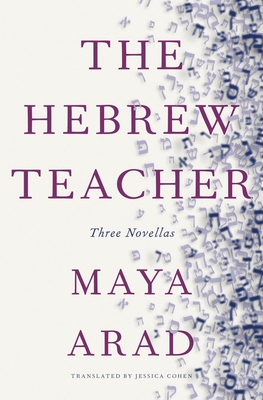
The Hebrew Teacher
- Author: Maya Arad
- Genre: Literary Fiction
- Publication Date: May 9, 2024
- Publisher: Dreamscape Media
Thank you to NetGalley and Dreamscape Media for providing me with an ARC of this audiobook in exchange for an honest review.
Plot Summary
Three Israeli women, their lives altered by immigration to the United States, seek to overcome crises. Ilana is a veteran Hebrew instructor at a Midwestern college who has built her life around her career. When a young Hebrew literature professor joins the faculty, she finds his post-Zionist politics pose a threat to her life’s work. Miriam, whose son left Israel to make his fortune in Silicon Valley, pays an unwanted visit to meet her new grandson and discovers cracks in the family’s perfect façade. Efrat, another Israeli in California, is determined to help her daughter navigate the challenges of middle school, and crosses forbidden lines when she follows her into the minefield of social media. In these three stirring novellas—comedies of manners with an ambitious blend of irony and sensitivity—celebrated Israeli author Maya Arad probes the demise of idealism and the generation gap that her heroines must confront.
Overall Impression
While I’m not usually a fan of short stories, this one sounded really interesting to me. Over the course of my life, I’ve known a few Israelis living in the United States, and while they always seemed content to me, I’ve always wondered what it’s like living in a different country than you grew up in. Come to think of it, I’ve been surrounded by immigrants for my entire life—my father lived in several countries before coming to America, and my family seems to attract a multicultural group of immigrants into our friendship circles, which makes me curious about moving to another country someday. Back to the book, though, the author is famous in Israeli bookish circles, and this is her first book made available in English, translated by Jessica Cohen. I couldn’t pass up this opportunity.
To start with, each short story felt long enough for the plot to unfold and keep me hooked. I was equally interested in each of the three stories: Ilana, a Hebrew instructor at a college in the Midwest struggling with the arrival of a new professor in her department; Miriam, who comes to California to visit her new grandson, but discovers a situation she wasn’t expecting; and Efrat, the mother of a girl in middle school, who is trying her best to help her daughter fit in, but goes too far.
Each story was populated with characters who felt realistic and never came across as flat. I found myself empathizing with not only the main characters, but some of the side characters as well. Much like in real life, there aren’t any characters who are singled out as all-out villains, but they’re more like people who are morally gray. I was amazed at Arad’s ability to create space for character development in short stories, and have them demonstrate growth in a limited time.
For Ilana, she seems to be fighting an uphill battle against staying relevant in a world that is increasingly moving on without her. She had initially moved from Israel to America to teach Hebrew at a Midwestern college for two years, but wound up staying for good. Since the job was what she moved to America for, Ilana wound up structuring her life around her career—she met her husband and all of her friends through the college, and looks forward to the gathering of the department. But when a new Hebrew literature professor joins the faculty and endorses some views that challenge not only Ilana’s own beliefs but her position within the department, she feels trapped and doesn’t know what to do. It’s a bit claustrophobic to be in her thoughts at times, but I found myself feeling so much empathy towards her.
When it came to Miriam, I really loved her character. She went through so much change in her section of the book—from when she first arrived and struggled with her expectations not meeting the reality, although from my understanding, her son and daughter-in-law weren’t thrilled about her coming for a three-week visit. It was beautiful to watch all of the characters learn how to adapt to each other and start to tentatively connect for the first time in a long time. It also highlights some cultural differences between Americans and Israelis in how they socialize.
Finally, Efrat is a mom who just wants to help her daughter, Libby. She’s in middle school and struggling to find her circle of friends, and Efrat starts to take small steps to help her along, but eventually she starts to have difficulty managing boundaries.
I’m really glad that I had the opportunity to read this book, and especially the chance to hear this as an audiobook, so that the beautiful accent of the Israeli characters came through in the reading—Ilana has a soft, muted accent as a result of spending many years in this country, while Miriam has a heavier accent. I loved listening to Robin Siegerman narrate this story.
It seems like boundaries are a running theme in the book, as well as finding a sense of home—not necessarily a place, but more of finding your people, a place where you feel comfortable and welcome. Family, both the kind that you’re born into and the kind that you choose for yourself, is another important theme that can be found in each of the three stories in this book, making it always interesting to read and relate to. Finally, the pace was nice and consistent for this story, and I know that I will be hoping for more translations of Maya Arad’s brilliant works.
 Functionally Fictional
Leave a comment